Rømmegrøt Recipe – Norwegian Sour Cream Porridge
Authentic Rømmegrøt Recipe | Norwegian Sour Cream Porridge – Rømmegrøt is a traditional Norwegian sour cream porridge made with just six everyday ingredients — full-fat sour cream, all-purpose flour, whole milk, salt, sugar, and cinnamon.
Rømmegrøt – Norwegian Sour Cream Porridge

Ingredients
- 2 cups Full fat sour cream
- 3/4 cup Flour
- 2 cups Milk
- 1 tsp Salt
- Sprinkling Sugar
- Sprinkling Cinnamon
- To taste Butter
Instructions
- Cook the sour cream in a covered saucepan on medium heat for about 5 minutes.
- Turn down the heat and add half of the flour and stir well with a whisk. Once the flour is fully incorporated, let the mixture continue to cook, stirring occasionally, until fat starts to release. Use a spoon to gather as much of the fat as you can in a small bowl, saving for later. (Don't worry if you can't get any fat – in that case you can add butter later.)
- Whisk in the rest of the flour and then slowly add the milk, whisking constantly to avoid lumps. Let the porridge continue to cook on low heat for 5 minutes and then add salt.
- Serve with sugar, cinnamon, and the fat from the porridge. If you're using lower fat sour cream you can top the rømmegrøt with some butter instead.
Nutrition
It takes about 25 minutes from start to finish, serves 4, and delivers one of the most genuinely comforting bowls of food you can make on a weeknight.
The technique is simple but a little surprising: you cook sour cream directly in a pot until it releases its own butter fat, then whisk in flour and milk to build a silky, slightly tangy porridge.
It sounds unhinged the first time you read it. It tastes incredible the first time you eat it.
This Rømmegrøt recipe is vegetarian, naturally gluten-containing, and deeply rooted in Norwegian food culture — served at everything from Christmas dinners to casual weeknight suppers.
If you enjoy exploring global comfort food, this one belongs in your rotation alongside dishes like this creamy Indonesian sweet potato dessert or a warming beef dumpling stew.
What Is Rømmegrøt?
Rømmegrøt is a centuries-old Norwegian porridge made by cooking full-fat sour cream (rømme) with flour and milk.
The name translates literally to “sour cream porridge” in Norwegian.
It has been a staple of Norwegian cuisine for generations, traditionally served at celebrations, harvest festivals, and Christmas.
Today it appears at family tables year-round as a comfort food — the Norwegian equivalent of congee or rice pudding.
- Indonesian Sambal Goreng Tempeh Recipe – Crispy & Spicy
- Easy Peach & Blueberry Grunt Recipe | Rustic Dessert
- Easy Turkey-Meatloaf Recipe That Kids Actually Love
- Best Cekodok Pisang Malaysian Banana Donuts Recipe
- Easy Homemade Lamb Rogan Josh Recipe | Indian Curry
- Tahini Lentils Recipe: Easy Weeknight Dinner
What makes it distinctive is the fat-separation step. When full-fat sour cream is heated, it releases clarified butter fat that pools on the surface. That fat is skimmed off and used as a rich topping, making the dish self-sufficient in a way that feels almost magical.
Key facts at a glance:
- Cuisine: Norwegian / Scandinavian
- Dish type: Porridge / comfort food
- Prep time: 5 minutes
- Cook time: 20 minutes
- Total time: 25 minutes
- Servings: 4
- Main ingredients: Full-fat sour cream, all-purpose flour, whole milk
- Dietary: Vegetarian
- Key technique: Fat separation from heated sour cream
Ingredients
The ingredient list for this Rømmegrøt recipe is short and entirely supermarket-friendly. Quality matters more than variety here — use the best full-fat sour cream you can find.
For the porridge:
- 500 g (2 cups) full-fat sour cream — do not substitute low-fat
- 75 g (¾ cup) all-purpose flour, divided
- 500 ml (2 cups) whole milk
- ½ tsp fine salt
For serving:
- 2–3 tbsp released butter fat (skimmed from the pot) or 30 g (2 tbsp) unsalted butter, melted
- 2 tbsp white or light brown sugar
- 1 tsp ground cinnamon
Do I Need Full-Fat Sour Cream?
Yes — full-fat sour cream (at least 35% fat) is essential for the butter-separation step. Low-fat versions contain too little fat to release the characteristic pools of clarified butter.
If full-fat sour cream is unavailable, use crème fraîche as a direct substitute. It has a similar fat content and behaves identically in the pot. You can still make the porridge with reduced-fat sour cream, but you will need to add 30 g (2 tbsp) of melted butter at the end instead of using released fat.
Equipment You’ll Need
- Medium heavy-bottomed saucepan with a lid
- Balloon whisk
- Wooden spoon or silicone spatula
- Small bowl (for collecting released fat)
- Ladle or large spoon (for skimming)
No specialist equipment is needed. A heavy-bottomed pan helps prevent scorching during the sour cream cooking stage.
Instructions
Step 1 — Heat the Sour Cream
Place the sour cream in a medium saucepan over medium heat. Cover with a lid and cook for 5 minutes, stirring once halfway through. The sour cream will loosen and become more liquid as it heats. Keep the lid on to prevent splattering.
You are looking for a gentle, steady heat — not a rolling boil. The sour cream should be hot and just beginning to bubble at the edges.
Step 2 — Add the First Flour Addition and Release the Fat
Reduce the heat to low. Add half the flour (approximately 38 g / 6 tablespoons) and whisk vigorously until fully incorporated with no lumps.
Cook on low heat, stirring every 60–90 seconds, for 5–10 minutes. You will see pools of golden butter fat begin to separate and rise to the surface. Use a spoon or ladle to skim this fat into a small bowl and set it aside. Some batches release more fat than others depending on the sour cream brand — both outcomes are fine.
Step 3 — Add the Remaining Flour
Whisk in the remaining flour (approximately 38 g / 6 tablespoons) until fully combined. Work quickly and thoroughly — this is your last opportunity to eliminate lumps before the milk goes in.
Step 4 — Add the Milk and Finish
Add the whole milk in four slow additions, whisking constantly between each pour. Do not rush this step — adding milk too quickly causes lumps.
Once all the milk is incorporated, cook on low heat for a further 5 minutes, stirring occasionally, until the porridge thickens to a consistency that coats the back of a spoon but still pours slowly. Stir in the salt. Taste and adjust seasoning.
Step 5 — Serve
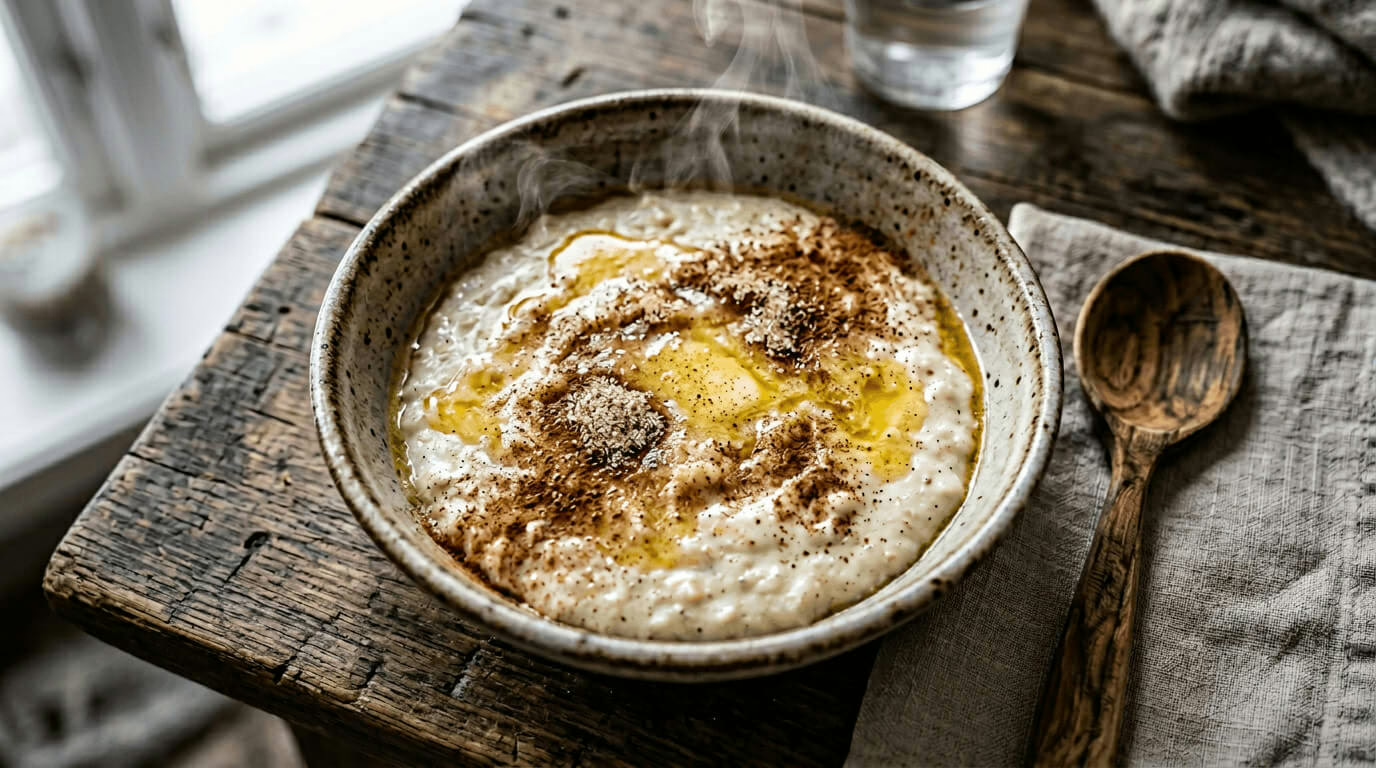
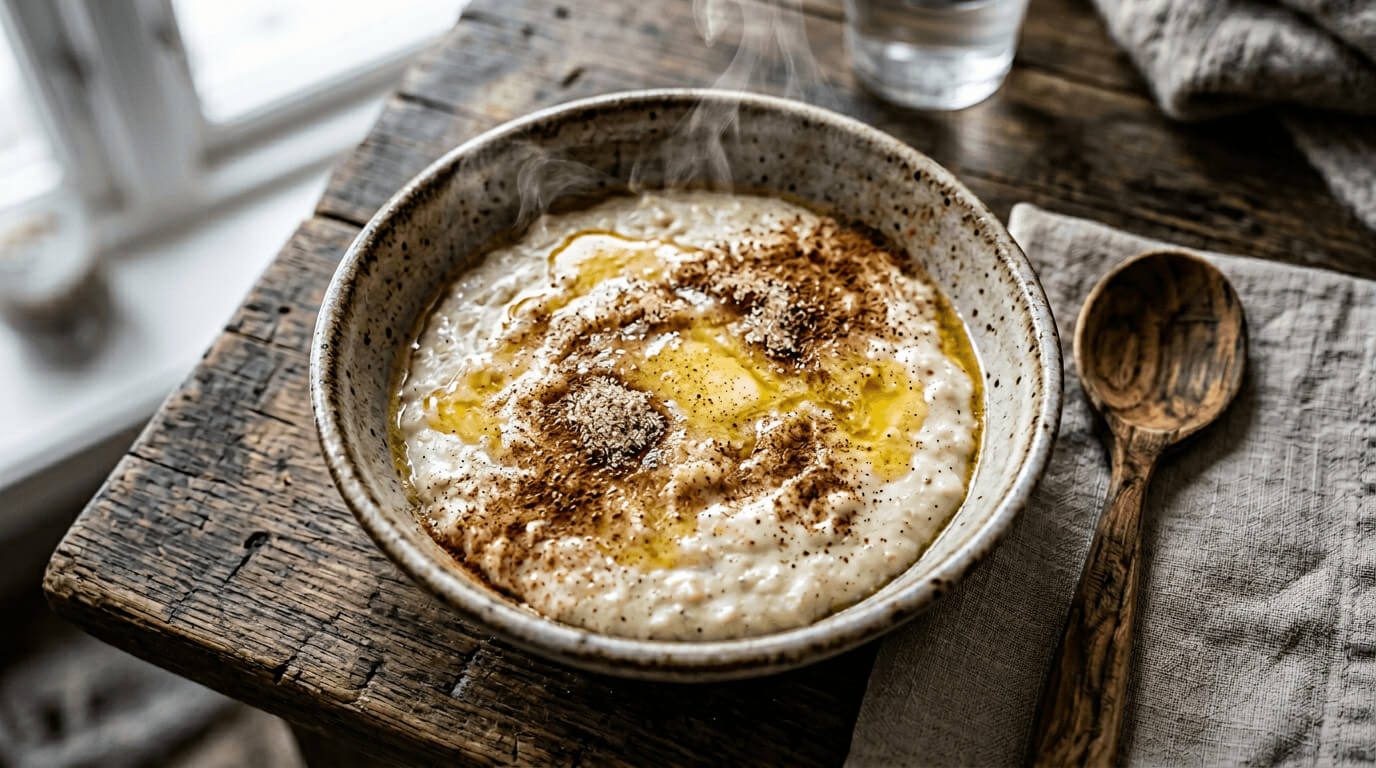
Ladle the Rømmegrøt into warm bowls. Drizzle the reserved butter fat (or melted butter) over the top. Combine the sugar and cinnamon in a small bowl, then dust generously over each serving. Serve immediately.
Can I Make Rømmegrøt Ahead of Time?
Yes — Rømmegrøt keeps well in the refrigerator for up to 3 days in a sealed container. It thickens considerably as it cools.
To reheat, transfer to a saucepan over low heat and whisk in a splash of whole milk (2–4 tablespoons) to loosen the texture. Stir continuously until warmed through and smooth. Microwave reheating works too — heat in 60-second bursts, stirring between each, and add a little milk as needed. Add fresh toppings after reheating.
Does Rømmegrøt Freeze Well?
Rømmegrøt is not ideal for freezing. The dairy-heavy base tends to separate and become grainy when thawed, and the texture does not fully recover even with vigorous whisking.
For best results, make only what you plan to eat within 3 days. The recipe scales down easily — halve all quantities for a two-person batch.
Tips for the Best Results
These are the lessons learned from making this Rømmegrøt recipe many times over.
Don’t panic during the fat-separation step. The pools of butter fat forming on the surface are exactly what you want. If your sour cream releases very little fat, simply use melted butter for serving. The porridge will taste just as good.
Add milk slowly. This is the step most likely to go wrong. Four gradual additions with constant whisking between each one will give you a smooth, lump-free result every time.
Cook on low heat throughout. Once the flour goes in, high heat will scorch the bottom of the pan. Keep it gentle and patient.
Aim for the right texture. The finished porridge should fall slowly from a spoon — thicker than soup, looser than stiff oatmeal. If it is too thick, whisk in a little extra milk. If too thin, cook for another 2–3 minutes.
Do not skip the toppings. The combination of butter fat, cinnamon, and sugar is not decorative — it is structural to the flavour. The sweet-salty-rich contrast is what makes this dish genuinely crave-worthy rather than just filling.
Brown sugar adds depth. Swapping white sugar for light brown sugar on top introduces a subtle caramel note that works beautifully with the tangy porridge base.
What Can I Serve with Rømmegrøt?
Traditionally, Rømmegrøt is served on its own as a complete dish — the butter, sugar, and cinnamon topping is considered integral, not optional. In Norway it is sometimes accompanied by cured meats such as spekemat (Norwegian dried lamb) or flatbread on the side.
For a modern serving approach, a small handful of fresh berries — lingonberries, raspberries, or blueberries — adds brightness and cuts through the richness. A pinch of ground cardamom mixed into the cinnamon sugar is a subtle upgrade worth trying.
If you enjoy warming, dairy-based comfort dishes from around the world, you might also like this easy homemade key lime pie for dessert, or explore a completely different comfort tradition with this chicken and mushroom hotpot.
The Cultural Background
Rømmegrøt has been part of Norwegian food culture for at least several hundred years. Historically, it was a celebratory dish — rich enough in dairy fat to be reserved for special occasions when cream and butter were plentiful.
It was traditionally served at midsummer (St. Hans), at weddings, and during the harvest season. In rural Norway, bringing a pot of Rømmegrøt to a neighbour who had just had a baby was a common gesture of community care.
Today it remains a beloved national dish, appearing on restaurant menus in Oslo and in home kitchens across the country. Its recent visibility on food social media reflects a broader global interest in Scandinavian cooking — an interest that goes well beyond the familiar territory of Swedish meatballs.
If you enjoy discovering comfort foods from different culinary traditions, the contrast between this Norwegian classic and something like a pork cassoulet from France or a matar paneer from India shows just how universally the idea of “rich, warming, dairy-based comfort” translates across cultures.
Frequently Asked Questions (FAQs)
Can I use crème fraîche instead of sour cream?
Yes — crème fraîche is the best substitute for sour cream in this recipe. It has a comparable fat content (typically 30–40%) and behaves identically during the heating and fat-separation steps. The flavour is slightly milder and less tangy, but the texture of the finished porridge is virtually identical.
Why is my Rømmegrøt lumpy?
Lumps form when flour is added too quickly or milk is poured in too fast. To fix lumpy porridge, remove the pan from the heat and whisk vigorously. If lumps persist, press the porridge through a fine-mesh sieve and return it to the pan. Prevention is easier: add flour in two separate stages and pour milk in four slow additions, whisking constantly between each one.
How much fat should separate from the sour cream?
The amount varies by brand and fat content. A 500 g batch of high-fat sour cream (35–40% fat) typically releases 3–6 tablespoons of butter fat. Some batches release as little as 1 tablespoon. If very little fat separates, simply use 30 g (2 tablespoons) of good-quality melted butter as a topping instead.
Can I make this recipe gluten-free?
Yes, with some adjustment. Replace the all-purpose flour with a 1:1 gluten-free flour blend. The porridge will still thicken, though the texture may be slightly less smooth. Rice flour also works but produces a thinner result — increase the quantity by about 20% if using rice flour.
Is Rømmegrøt suitable for children?
Yes — Rømmegrøt is a mild, dairy-rich dish with no spice or allergens beyond milk and gluten. It is a traditional Norwegian children’s food. Reduce or omit the sugar topping for very young children, or serve with a drizzle of honey instead.
What is the correct consistency for Rømmegrøt?
The finished porridge should be thick enough to coat the back of a spoon but loose enough to pour slowly into a bowl. Think of it as midway between thick cream soup and soft-set oatmeal. It will continue to thicken as it cools, so err slightly on the looser side when cooking.
Can I add flavourings to the porridge itself?
The traditional recipe keeps the porridge base plain, with all flavouring coming from the toppings. However, a pinch of ground cardamom or vanilla extract stirred into the finished porridge works well. Some modern versions add a small amount of honey to the base. Avoid adding cinnamon directly to the porridge — it can make the texture slightly gritty.
How does Rømmegrøt compare to other porridges?
Rømmegrøt is richer and more calorie-dense than oatmeal or rice porridge because its base is sour cream rather than water or plain milk. It is tangier than rice pudding and smoother than polenta. The closest international comparison is a very rich, savoury-leaning version of semolina pudding. If you enjoy easy banana pancakes or other simple, dairy-forward breakfast dishes, Rømmegrøt will feel immediately familiar in spirit.