Easy Ugali Recipe – Kenyan Cornmeal (2 Ingredients)
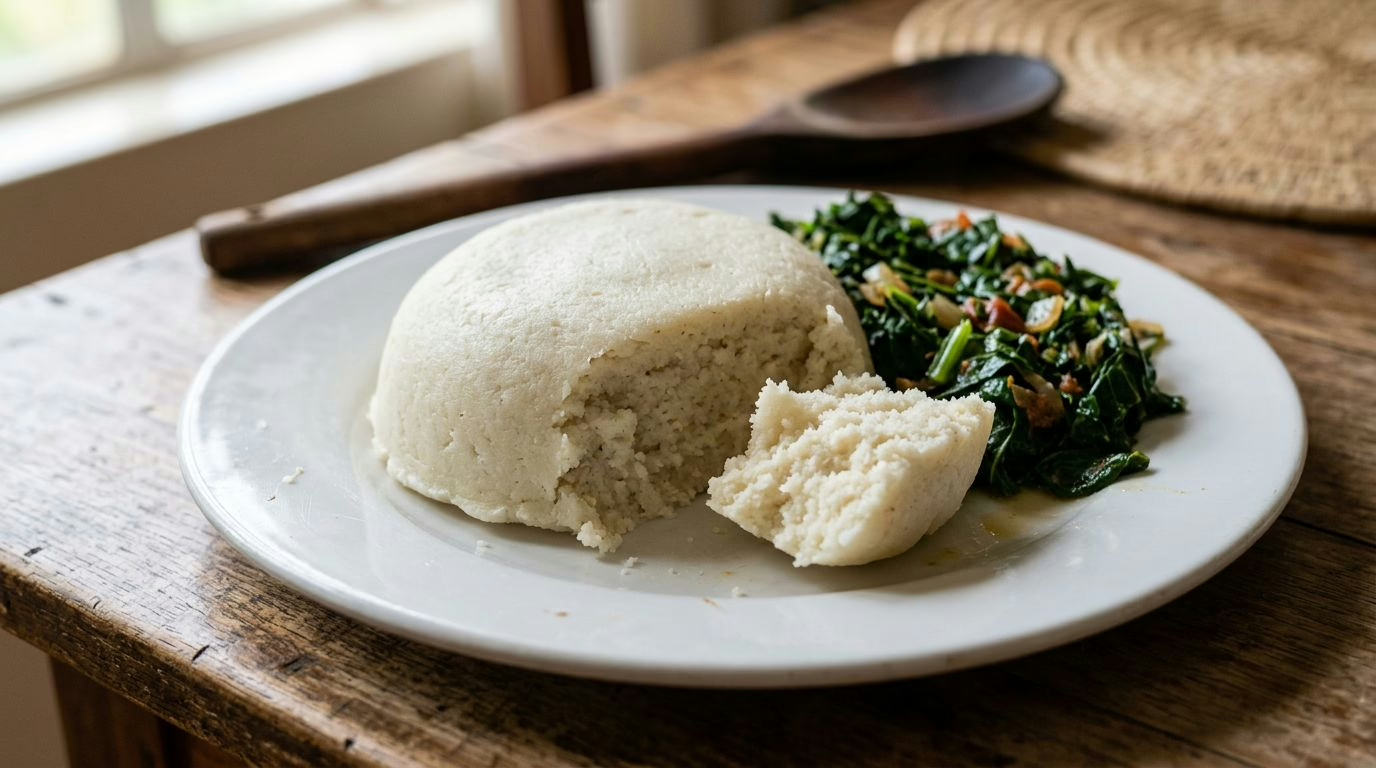
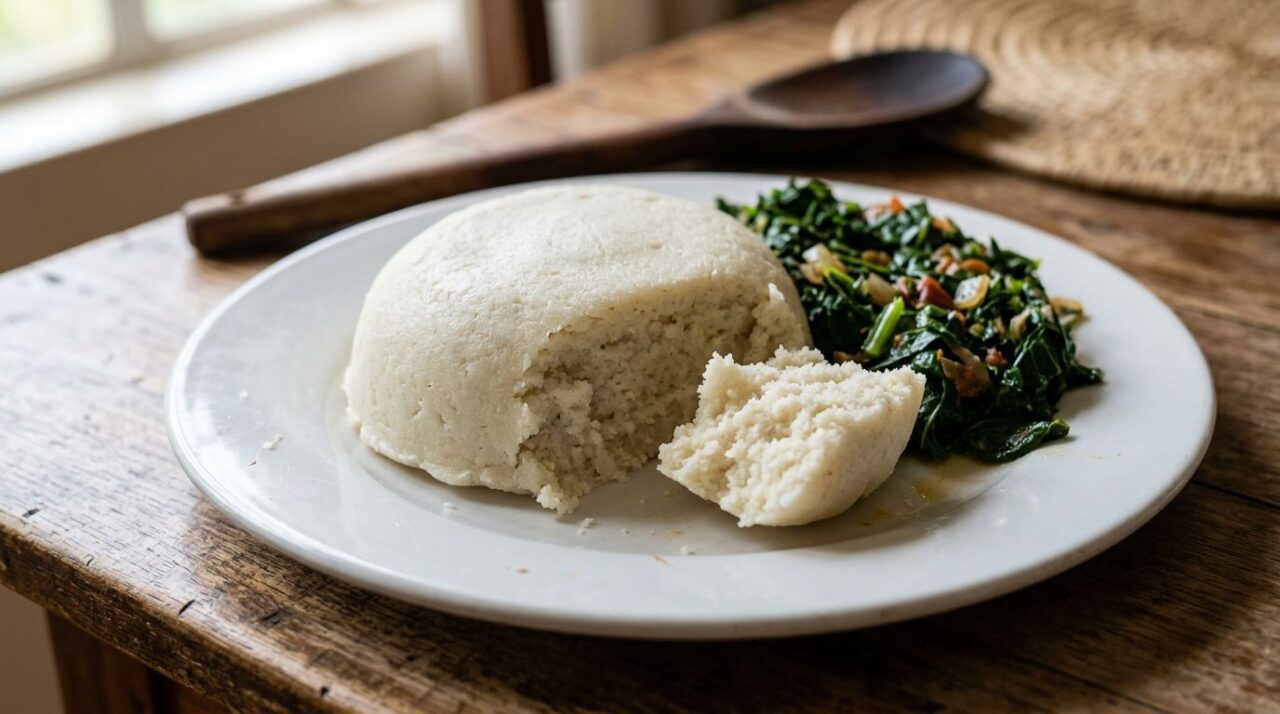
Ugali Recipe: How to Make Kenyan Cornmeal at Home – Ugali is a firm, dough-like Kenyan cornmeal staple made from just white maize flour and water.
Ugali – Kenyan Cornmeal

Ingredients
- 2 cups Water
- 1 1/2 cups White Cornmeal
Instructions
- Bring the water to a boil in a medium saucepan.
- Reduce the heat to low, and stirring constantly with a whisk, slowly add the cornmeal to the boiling water. The ugali will begin to thicken quite quickly.
- Continue cooking on low heat, stirring constantly with a sturdy wooden spoon, until the ugali begins to pull away from the sides of the pan, hold together, and takes on the aroma of roasted corn. Turn it out immediately onto a serving plate. If you would like, using a spoon or spatula, quickly shape it into a thick disk or round.
- The ugali will continue to firm as it cools and will be thick enough to cut with a knife (similar to firm polenta).
Nutrition
This easy ugali recipe takes 15 minutes, serves 4, and pairs with any stew, greens, or grilled meat. It is naturally vegan, gluten-free, and one of the most budget-friendly carbs you can make from scratch.
Cuisine: East African (Kenyan) | Prep time: 2 minutes | Cook time: 10–12 minutes | Total time: 15 minutes | Servings: 4 | Dietary: Vegan, gluten-free | Key technique: Constant stirring over low heat
What Is Ugali?
Ugali is the carb backbone of East African cuisine, eaten daily across Kenya, Tanzania, and Uganda.
It is made from white maize flour (cornmeal) and water, cooked until it forms a thick, firm, dough-like mass you can shape, slice, and tear.
Think of it as polenta’s more structured cousin.
Where polenta is creamy and pourable, ugali is dense enough to hold its shape and sturdy enough to scoop up saucy stews without falling apart.
It is comfort food in the truest sense — filling, honest, and deeply satisfying.
Ugali is traditionally eaten with sukuma wiki (sautéed collard greens), nyama choma (grilled meat), or any bean or vegetable stew.
Diners tear off small pieces with their hands, press a thumb indent into each piece, and use it as an edible scoop. Once you try it this way, utensils feel unnecessary.
Ingredients
This ugali recipe uses just two ingredients. The quality of your cornmeal makes a real difference to the final texture.
- 1½ cups white maize flour (also sold as white cornmeal or maize meal — see note below)
- 2 cups water
On the cornmeal: White maize flour gives ugali its traditional smooth, ivory texture. Yellow cornmeal works in a pinch but produces a slightly grainier result. Do not use masa harina — it is treated with lime and will taste wrong. Find white maize flour at African or Caribbean grocery stores, or in the international aisle of larger supermarkets.
On salt: Traditional ugali is unsalted. It is designed to be a neutral vehicle for flavorful sauces and stews. You can add a pinch of salt if you prefer, but it is not traditional and makes little noticeable difference.
Equipment You’ll Need
- Medium saucepan (2-quart / 1.9-litre)
- Whisk
- Sturdy wooden spoon (not a thin spatula — ugali is thick and will break flimsy tools)
- Serving plate or board
Instructions
Follow these steps carefully. The technique matters more than the ingredient list.
Step 1 — Boil the water
Bring 2 cups of water to a full rolling boil in your saucepan over medium-high heat. You need real bubbles, not just steaming water.
Adding cornmeal to under-boiled water causes lumps.
Step 2 — Reduce heat and add cornmeal slowly
Reduce the heat to low. Begin adding the 1½ cups of white maize flour in a slow, steady stream while whisking constantly. Do not dump it all in at once.
The mixture will begin thickening almost immediately — this is normal.
Step 3 — Switch to your wooden spoon
Once all the cornmeal is incorporated and you have a thick, lump-free mixture, swap the whisk for your sturdy wooden spoon.
This is where the real work begins.
Step 4 — Stir constantly for 8–10 minutes
Keep stirring over low heat without stopping. The ugali will thicken steadily and you will feel increasing resistance with each stir.
Cook for 8–10 minutes total until the ugali pulls cleanly away from the sides of the pan, holds together as one firm mass, and smells of roasted corn.
That roasted aroma tells you the raw flour taste is gone.
Step 5 — Turn out and shape
Immediately turn the ugali out onto your serving plate. Work quickly — it firms up fast as it cools.
Use the back of a wet spoon or spatula to smooth it into a dome or thick disk. Let it rest for 1–2 minutes to firm up before serving.
The Stirring Step
Constant stirring is the single most important technique in this ugali recipe. Stopping — even briefly — allows a burnt layer to form on the bottom of the pan, which creates a bitter flavour that ruins the whole batch.
Your arm will get tired. That is expected. Put on a podcast, commit to the 8–10 minutes, and keep the spoon moving.
Low heat is essential here: medium or high heat scorches the bottom before the inside is properly cooked.
The payoff is real. When ugali is stirred correctly over low heat, it develops a subtle roasted corn flavour and a smooth, cohesive texture that no shortcut can replicate.
What to Serve With Ugali
Ugali is a neutral base designed to carry bold, saucy dishes. These are the most traditional and popular pairings.
Sukuma wiki — Sautéed collard greens with tomatoes and onions. This is the classic Kenyan combination and the one most Kenyans eat most often. Simple, cheap, and genuinely delicious.
Nyama choma — Kenyan-style grilled meat, usually goat or beef. The ugali soaks up the meat juices in a way that rice simply cannot match.
Bean or lentil stew — Any thick legume stew works beautifully. The ugali absorbs the sauce and makes the meal genuinely filling.
Kachumbari — A fresh Kenyan tomato and onion salad, often served alongside the main dish to add brightness and acidity.
Ugali also works surprisingly well beyond Kenyan cuisine.
Its neutral flavour makes it a natural partner for any saucy dish — try it alongside a hearty kidney bean curry or a warming nutty chicken curry for an easy weeknight dinner.
If you enjoy exploring global staple carbs, the easy lontong recipe — Indonesian compressed rice cakes — follows a similarly simple two-ingredient logic.
Can I Use Yellow Cornmeal Instead of White?
Yes, you can use yellow cornmeal to make ugali, but the result will differ slightly.
Yellow cornmeal produces a more golden colour and a marginally grainier texture compared to the smooth, ivory finish of traditional white maize flour.
The flavour difference is subtle but present — white maize flour has a milder, cleaner taste that lets the accompanying stew or sauce take centre stage.
Yellow cornmeal has a slightly stronger corn flavour. Both versions are edible and satisfying; white is simply more authentic.
Do not use masa harina as a substitute. Masa harina is treated with lime (nixtamalised), which gives it a distinct flavour that is wrong for ugali.
Is Ugali Gluten-Free?
Yes, ugali is naturally gluten-free. It is made entirely from maize flour (cornmeal) and water, with no wheat, barley, or rye involved.
If you are cooking for someone with coeliac disease or a serious gluten intolerance, check your cornmeal packaging for a certified gluten-free label.
Some facilities process both corn and wheat products, which can introduce cross-contamination. A dedicated gluten-free maize flour eliminates that risk.
Can I Make Ugali Ahead of Time?
Ugali is best eaten fresh and warm, straight from the pan. It firms up significantly as it cools and can become dry and dense if left to sit for more than 20–30 minutes.
That said, leftover ugali is genuinely good the next day. Slice it into thick rounds or wedges and pan-fry them in a little oil over medium heat for 2–3 minutes per side until golden and slightly crispy on the outside.
It becomes a completely different — and excellent — thing. You can also reheat it in a microwave with a splash of water, covered, for 1–2 minutes, though the texture will be softer than fresh.
For meal prep, make the accompanying stew or sauce ahead of time and cook the ugali fresh just before serving. It only takes 15 minutes, so this is the most practical approach.
Tips for Perfect Ugali Every Time
These are the lessons that took a few failed batches to learn.
Use the correct water-to-cornmeal ratio. The 2 cups water to 1½ cups maize flour ratio in this recipe produces firm, sliceable ugali.
Less water makes it too stiff and dry. More water makes it too soft to hold its shape.
Different brands of maize flour absorb water slightly differently, so adjust by a tablespoon or two if needed after your first batch.
Always start with a full rolling boil. Adding cornmeal to water that is merely hot — not boiling — causes uneven hydration and lumps that are difficult to whisk out.
Add the cornmeal in a slow, steady stream. Pouring it all in at once is the fastest route to a lumpy, uneven texture.
Slow and steady gives you a smooth result every time.
Keep the heat low throughout. Medium or high heat scorches the bottom of the pan before the ugali is fully cooked.
Low heat lets it cook evenly and develop that roasted corn aroma without burning.
Eat it with your hands. Tear off a small piece, press your thumb into it to create a small cup shape, and use it to scoop up stew or greens.
This is the traditional method and it genuinely works better than a fork. The ugali is firm enough to hold saucy food without collapsing.
Vegan and Budget-Friendly Notes
Ugali is one of the most naturally vegan and budget-friendly staple foods in the world.
Two ingredients, no animal products, no expensive equipment, and a total cost of well under $1 per serving when using bulk maize flour.
It fits comfortably into plant-based meal planning alongside vegetable stews, bean dishes, and sautéed greens.
If you are building a repertoire of affordable global plant-based staples, ugali deserves a regular spot.
For more inspiration, the easy vegetarian chilli recipe makes an excellent ugali pairing, and the matar paneer recipe — though not vegan — shows how a simple legume-based sauce can elevate a plain starch into a complete meal.
Frequently Asked Questions (FAQs)
How do I know when ugali is fully cooked?
Ugali is fully cooked when it pulls cleanly away from the sides of the pan as you stir, holds together as a single cohesive mass, and smells of roasted corn rather than raw flour. These three signs together — not just one — confirm it is done. Undercooked ugali tastes starchy and gummy.
Why did my ugali turn out lumpy?
Lumps form when cornmeal is added too quickly to the boiling water, or when the water was not at a full boil when you started. Add the maize flour in a slow, steady stream while whisking constantly, and make sure you have real rolling bubbles before you begin. If lumps do form, whisk vigorously — most small lumps can be smoothed out before the mixture gets too thick.
How much ugali should I make per person?
A standard serving is roughly 100–120g (about ¾ cup) of dry maize flour per person. This recipe using 1½ cups of maize flour comfortably serves 4 as a side dish alongside a stew or protein. If ugali is the main carb for hungry adults with no other starchy sides, plan for 2–3 generous servings from this quantity.
Can I add flavour to ugali?
Traditional ugali is plain and unsalted — its neutrality is the point. However, you can add a pinch of salt to the boiling water without breaking any rules. Some cooks stir in a small amount of butter at the end for a richer finish. Cooking the water with stock instead of plain water adds a subtle savoury depth, though this moves away from the traditional preparation.
What is the difference between ugali and sadza or nsima?
Ugali, sadza (Zimbabwe), and nsima (Malawi and Zambia) are all the same basic dish — maize flour cooked with water to a firm, dough-like consistency. The name changes by country and region, but the technique and ingredients are essentially identical. In some regions, white sorghum flour or a mix of flours is used instead of pure maize flour, which produces a slightly different colour and flavour.
Can I cook ugali in a non-stick pan?
Yes, a non-stick pan works well for ugali and makes cleanup easier. The key advantage is that the risk of scorching the bottom is slightly reduced. However, a standard saucepan works perfectly fine as long as you keep the heat low and stir constantly. Avoid thin, lightweight pans — they heat unevenly and make burning more likely.
How do I store and reheat leftover ugali?
Allow leftover ugali to cool completely, then wrap it tightly in cling film or store it in an airtight container in the refrigerator for up to 3 days. To reheat, microwave with a splash of water, covered, for 1–2 minutes until warmed through. Alternatively, slice into rounds and pan-fry in a little oil for 2–3 minutes per side for a crispy, golden result that many people prefer to the fresh version.